
EMIS-Enabled Switch-Off Savings Across an SME Portfolio
Small and Mid-Sized Manufacturers · Southern Ontario
Small and mid-sized manufacturers are usually the last candidates considered for a metering and analysis program. They rarely have an energy manager on staff, their capital budgets are tight, and a facility running a handful of production lines is often assumed too small to justify the cost of granular metering, let alone the ongoing analysis to act on it.
Across a portfolio of SME manufacturing sites in Ontario, ranging from formulated-product manufacturing to metal component production, Panevo tested that assumption directly. The IESO's retrofit program funds sub-metering hardware as an eligible measure in its own right, which meant the metering itself could be installed at 50% net cost to the site. The open question was whether the data it produced, on its own, could still find savings at a scale that mattered to a small operator.
It was. Reviewing interval data down to the individual line and asset level, nearly every metered asset across the portfolio turned up at least one identifiable opportunity: equipment left running outside production hours, assets sequenced inefficiently or selected incorrectly, or schedules that had never been revisited since installation.
No energy staff to watch the data: a small manufacturer rarely has anyone whose job is to review metering trends, so metering without ongoing analysis and alerting delivers little on its own.
Assumed too small to matter: a facility with a handful of production lines is often written off as not having enough load to make a metering and audit program worth the cost.
Tight capital budgets: equipment-replacement projects are a hard sell at this scale, which is exactly why savings that require no capital investment carry outsized value here.
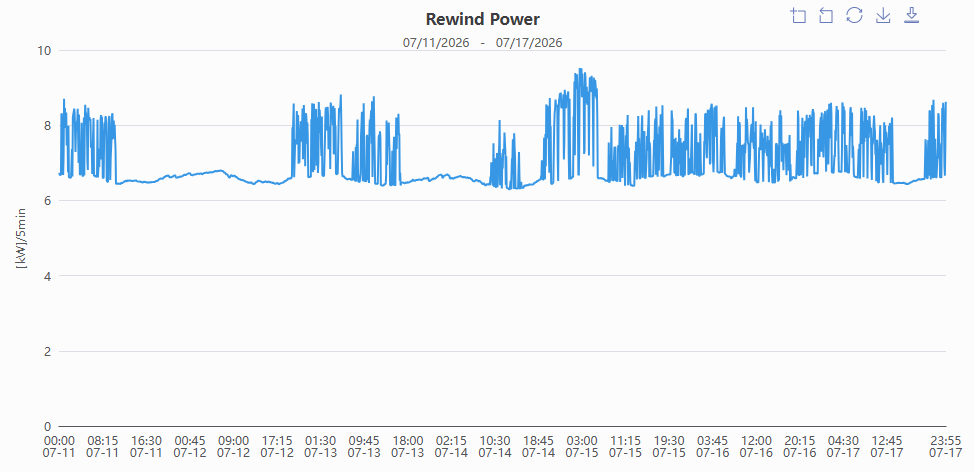
A load that never shut off: This chart shows an asset the interval data caught holding a steady 6.5 to 9 kW draw through nights and weekends alike, with no period where it dropped to zero. Once flagged and investigated by Panevo, the site noted its operation was manually controlled by a dial, with no reason for off-hour consumption. Shutting it down the rest of the time took no capital, only a documented start and stop procedure.
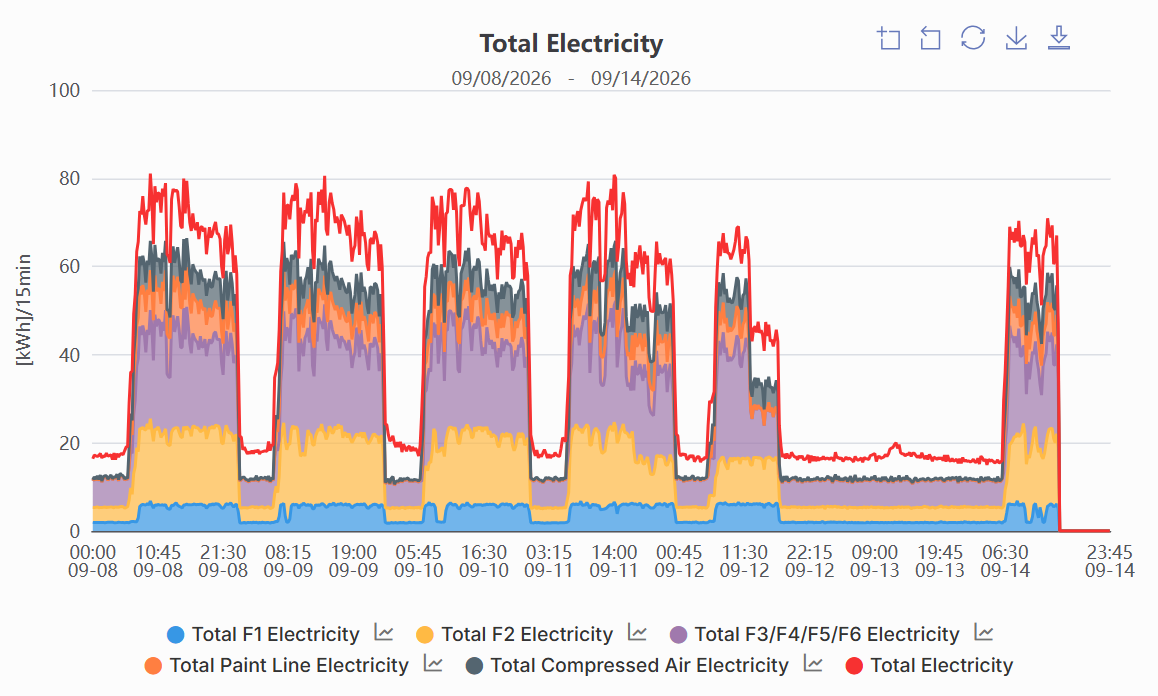
Seeing where the load actually goes: Here's an example of a whole-facility electricity balance broken down by sub-metered process area. Splitting the daily peak out by area made it clear which processes were driving load during production, and just as usefully, it isolated the roughly 80 kW base load that persists even when production stops each night, and over the weekend, which is exactly the standing load worth investigating asset by asset.
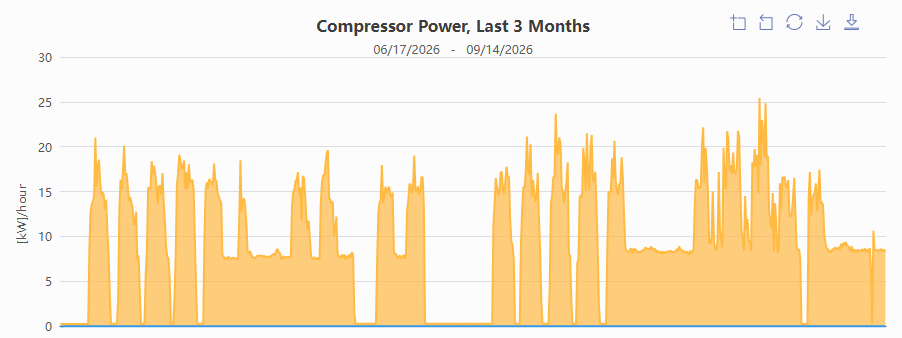
Idle equipment caught in the act: In one case, an air compressor was caught by the interval data running inconsistently outside any production window, which the site noted was due to operator error. Once flagged, shutting it off outside shift hours took no capital and no process change beyond turning it off. ioTORQ alerts configured with Panevo guidance make that identification free, to ensure sustainment of the savings opportunities. Projects tracked in the site's ioTORQ Action Tracker ensure that savings and performance are captured and presentable to management.
IESO-supported, high-coverage metering: Installed sub-metering on production lines, utility mains, and major asset groups at each site under IESO's retrofit incentive program, which part-funds metering hardware as an eligible measure and made it possible to prioritize coverage across every significant end use rather than a single point of measurement.
Asset-level data review: Analyzed interval data down to the individual line and asset level rather than whole-facility trends, which is what surfaced equipment running outside production hours or cycling inefficiently.
A follow-up audit, not just a report: Returned to each site in person to walk the data through with site staff and turn it into concrete recommendations: specific assets to shut off, sequencing changes between pieces of equipment, and revised start and stop schedules.
ioTORQ alerts for sustainment: Configured ongoing alerts on the flagged assets so a shutoff or schedule change identified once keeps paying off long after the review, without requiring a site's own staff to monitor it.
Justifying capital for metering with an uncertain return: a small manufacturer sizing up a metering project has no way to know in advance how much it will find, unlike a piece of equipment with a stated payback. That made metering a hard capital case on its own, even with the IESO's incentive covering part of the hardware cost, since the remaining spend still had to be justified without a guaranteed number attached to it.
No one on site to keep watching the data: unlike a large plant with a dedicated energy manager, none of these sites had staff who could monitor metering trends day to day. ioTORQ alerts had to do that ongoing watching instead, so a savings opportunity found once would not quietly disappear a few months later.